Friday, September 21, 2012

International Peace Day from Kabul, Afghanistan


On this International Day of Peace I am sitting in Kabul, Afghanistan with a handful of youth that want nothing but peaceful coexistence in their lives. This in some respects is like a dream because their entire lives have been surrounded by war, death, corruption, and struggle. Peace has been in short supply. For three years the Afghan Peace Volunteers have worked to develop friendships across ethnic lines in Kabul and various provinces throughout Afghanistan.  The work has been difficult, trust is hard to come by in this war torn land, but they are adamant that non-violence is the only way forward. I have sat with similar groups in the West Bank, Gaza, Lebanon, Iraq, America and Israel. Rarely are their voices heard over the drums of war.

Established in 1981, by the United Nations General Assembly, the International Day of Peace was to coincide with its opening session. The first Peace Day was observed on September 21st, 1982. In 1982 the Soviet Union was increasing its troop presence in Afghanistan and facing fierce fighting throughout the provinces.

Thirty years later Afghanistan is still at war. The opponents have changed, and the weaponry has changed. The War on Terror, Armored Humvees, IED’s, suicide bombers, night raids, smart bombs, and drones have all entered the American lexicon. 

The constant through all these years is the suffering of the non-combatants. Just this week, a van was blown up by an IED in southern Helmand province, killing 9 women and 3 children. No group has claimed responsibility for the blast. A drone strike before dawn in Laghman Province killed 8 women gathering firewood and injured 8 more. I spoke with a father of six children in ParwanSa refugee camp. He has been an Internally Displaced Person for 11 years, living in a small mud-brick enclosure with a plastic, canvas, and cardboard roof. I asked if the government had offered any assistance for the coming winter. He said the government has done nothing; he could only count on God to take care of his family. Oct 7th will mark the 11th  anniversary of America’s war in Afghanistan. 11 years and $550 billion dollars later, peace is still elusive.

The war has pushed the Taliban out of power, but the current government is full of the very same warlords that were carving up Afghanistan prior to the Taliban’s rise. These “representatives” have very little backing among the people, mainly because they have continued to line their pockets while their constituents suffer. The call for peace may fill their speeches, but to work for peace distracts from their income.

The International Security Assistance Forces (ISAF) as well as the Afghan Army and Afghan Police force, often employing strong-arm tactics,  struggle to bring a semblance of security to the countryside. Security in Kabul is tentative as well, with suicide bombings and armed attacks on the rise. On Sept 18th, a woman rammed a car full of explosives into a van containing 9 foreign workers, killing herself, all 9 foreigners, their Afghan translator, as well as passerby. While temporary security may be imposed with an iron fist, peace cannot be forced.

On Sept 19th, an Afghan holiday in the remembrance of the death of Burhanuddin Rabbani, a warlord turned “peace envoy” who was killed by a suicide bomber in his home, President Hamid Karzai called on Afghans to pursue peace. A generation that has known nothing but war has little faith in government calls for peace while the very same government loots the country. The government led peace initiative seems to have died with Rabbani a year ago.

The past week has been disastrous for Afghans, and points towards more mayhem in the future.  While profits are still being generated for arms suppliers, reconstruction experts, and contractors, peace has not been generated for anyone. In America, peace is never spoken of outside the context of war or security. In Obama’s acceptance speech in Charlotte, he mentioned America’s “pursuit of peace” exactly once, shortly after getting cheers for claiming, “Osama bin Laden is dead.”

A partial list of American military involvement since 1982 includes Lebanon, Grenada, Chad, Libya, Honduras, Bolivia, Columbia, Peru, Philippines, Panama, Iraq, Kuwait, Somalia, Bosnia, Macedonia, Haiti, Serbia, Afghanistan (currently, America’s longest war), Sudan, Iraq (again, after years of crippling sanctions that killed half a million children), and Libya (again). This is not an exhaustive list, it doesn’t include covert attacks, special operations, or America’s special relationship with Israel, which has rained down horror on Lebanon, the West Bank and Gaza. Israeli drones continue to kill people in Gaza on a nearly weekly basis. American drones are currently killing people in Afghanistan, Pakistan, Yemen, and Somalia. Syria and Iran loom on the horizon, with American threats of intervention and war ramping up. Death is a top American export.

On the anniversary of Sept 11th, a hate filled Anti-Islam movie trailer was a catalyst sparking widespread protests and attacks across the world, leading to 30 deaths. On Sept 19th a French Satirical newspaper, under the guise of “free speech” released vulgar cartoons of the Prophet Mohammad (Peace be Upon Him) adding fuel to an already volatile fire. Peace Day is likely to be fraught with violence, like most any other day.

Yet, on this International Day of Peace groups will come together around the world (and yes, even in Afghanistan) to promote peace, cooperation, friendship and love. These efforts are necessary, if for no other reason then to remind people peace is an option, a possibility, and a personal responsibility. It is necessary to counter the flames of hatred. It is necessary to be inspired by those who walked this path before us. It is necessary for our sanity as human beings. As the darkness of our violence prone world threatens to overwhelm us, it is necessary to dance, to sing, to laugh, and to open our minds to creative opportunities to live in harmony with our world. It is necessary to stand together for even just one day and say, “No, just because you have superior firepower, or can rain down hell fire missiles, or fly planes into buildings, I will not be swayed, I will not live in fear. Your sickness will not persuade me, infect me, or deter me.” In this electoral season, choosing between Obama and Romney is a huge distraction, there is real work to be done. Our perverse system of endless war needs to be dismantled, our culture realigned. We need to begin again. War is over. Peace is the path.

Tuesday, September 11, 2012

“We are at War. Somebody is Going to Pay.” George W. Bush, Sept 11th, 2001


Eleven years later, we are still at war. Bullets, mortars and drones are still extracting payment. Thousands, tens of thousands, millions have paid in full. Children and even those yet to be born will continue to pay for decades to come.

On a single day in Iraq last week there were 29 bombing attacks in 19 cities, killing 111 civilians and wounding another 235.  On Sept 9th, reports indicate 88 people were killed and another 270 injured in 30 attacks all across the country. Iraq continues in a seemingly endless death spiral into chaos. In his acceptance speech for the Democratic nomination for President, Obama claimed he ended the war in Iraq, well… not quite.

The city of Fallujah remains under siege. Not from U.S. troops, but from a deluge of birth defects that have plagued families since the use of depleted uranium and white phosphorus by U.S. forces in 2004. No government studies have provided a direct link to the use of these weapons because no government studies have been undertaken, and none are contemplated.

Dr. Samira Alani, a pediatric specialist at Fallujah General Hospital, told Al Jazeera,
"We have all kinds of defects now, ranging from congenital heart disease to severe physical abnormalities, both in numbers you cannot imagine. There are not even medical terms to describe some of these conditions because we've never seen them until now." The photographs are available on line if you can bear to look at what we have wrought. George W. Bush will loudly proclaim his “Pro-life” bona fides, and he’ll tell you he believes “that every child, born and unborn, ought to be protected in law and welcomed into life.” Apparently, “every child” doesn’t apply to the children of Fallujah, and the “law” doesn’t apply to George W. Bush.

Our soldiers, some physically damaged by IED’s, some mentally destroyed by PTSD, will pay for these wars for the rest of their days. Drug and alcohol abuse is out of control. Suicide among the troops is an epidemic. 2,916 Americans were lost in the towers on that fateful day, many, many more have perished in the intervening years.

Today we will be asked to honor the men and woman of our armed forces, but what does honoring the veterans entail? In its most recent report, The Veterans Administration estimates about 107,000 veterans are homeless on any given night. Mental illness plagues 45% of homeless vets and 70% suffer from some kind of substance abuse. So how do you honor our veterans? Are “Support Our Troops” ribbons still in vogue? How does our government honor our veterans other than use them as political pawns in stump speeches and cannon fodder for their wars?

84,000 American troops remain in Afghanistan. While the occupation is rarely mentioned in the U.S. mainstream media, that doesn’t mean the killing has stopped. On average, one U.S. soldier dies everyday.  Not an enormous sum, unless it is your mother, father, son or daughter that has perished. Few Americans notice. Afghan loses are not reported. They have loved ones who grieve as well.

The American public has turned their attention to feeding their families, keeping their homes, and finding employment. But what of the $2 billion dollars per week we are spending on war in Afghanistan? What would $2 billion per week look like in our devastated communities, in our schools, in creating jobs or in caring for our elders? Politicians in both parties claim our first priority is to reduce the debt. If they were really serious, if they were honest, they would end this occupation and stop calling for cuts to Medicaid, Food Stamps, and Social Security.

And what is the price extracted from the Afghan people? Security is still a dream, even in Kabul. As I write this 6 people have perished in a suicide bombing outside NATO headquarters, in the heart of Kabul. Several of them were impoverished street kids, peddling packs of gum to the westerners who frequent the area.

Hilary Clinton, Madeline Albright, Jan Schakowsky, and other prominent American women claim American forces are necessary in Afghanistan to protect the gains made in woman’s rights. On Sept 6th, Emma Graham-Harrison reported in the Guardian that 3 women in Kabul were attacked by a group of men because of their work as television actresses. One of the women was murdered. After seeking treatment at the hospital, the two survivors were taken to prison, where they face intrusive virginity tests and possible charges of prostitution or collusion in the attack. They face long prison sentences. This is not the Taliban; this is woman’s rights in Afghanistan today, rights that Hilary Clinton fears will be rolled back!

On the streets of Kabul it is not unusual to see burka clad women clutching starving children begging for spare change. Poverty and hunger is even worse in Kandahar and Helmand, areas that have seen some of the most intense fighting of the war. In southern Afghanistan 29.5% of the children are suffering from severe malnutrition. This compares to famine stricken areas of Africa, yet, officially, there is no famine in Afghanistan and hundreds of millions of dollars of humanitarian aid has flowed into the country.

In America, 35 million people are hungry or do not know where their next meal is coming from and 13 million of them are children. Who benefits from the  “War on Terror”?

On Sept 2nd, Hamid Karzai announced his choice for the new intelligence chief, Asadullah Khalid. Khalid is currently the country's minister of tribal and border affairs who oversees its southern security forces. In 2009 Richard Colvin, Canada's former deputy ambassador to Afghanistan, testified before Canada's parliament that his team had uncovered "very credible" evidence of torture, which allegedly included Khalid's direct involvement. “He was known to have had a dungeon in Ghazni, his previous province, where he used to detain people for money, and some of them disappeared," Colvin said in his testimony. "He was known to be running a narcotics operation. He had a criminal gang. He had people killed who got in his way." Khalid and Karzai dismiss the allegations as unfounded.

In Kabul, children freeze to death in the winter, and they starve to death all year round.  Meanwhile on the edge of Kabul a “New City” is being built. Hamid Karzai’s brother, Qayum Karzai, the owner of a construction company, benefits as his company “wins” government contracts without the hassles of competitive bidding. Karzai’s relatives are also benefiting from lucrative contracts in the oil and mineral sectors. In late 2011, Watan Oil and Gas, a company controlled by President Karzai’s cousins Rateb and Rashid Popal gained a contract with China’s National Petroleum Corporation. In 1989 Rateb was convicted for smuggling drugs in the U.S. and spent more than eight years in prison. The Popal family’s company Watan Risk Management also worked as a contractor for the US forces. In 2010, they were accused of paying off Taliban insurgents with a cut from NATO contracts. According to the NY Times, another brother, Ahmed Wali Karzai was involved in the heroin trade and was also on the CIA’s payroll for several years before his assassination in 2011. The Karzai family now brings in billions of dollars a year. 42% of Afghans live on less than a dollar a day. So we are bent on ridding Afghanistan of the Taliban while the government is full of warlords, gangsters, and drug dealers.

Since America’s intervention in Afghanistan, the heroin trade has exploded, doubling opium production. Afghanistan is now the source of 90% of the world’s heroin. This dovetail’s nicely with America’s “War on Drugs.”

The growth in the heroin trade coupled with the despair of daily living has contributed to an eruption of drug addiction. Addicts can be found huddled under bridges throughout Kabul. As these men succumb to addiction, their families are left to fend for themselves. Heroin floods the streets of Europe and Russia. Which banks benefit from the enormous cash flows generated by the heroin trade? Who in the Afghan government benefits?

The corruption is mind-boggling. We support terrorist elements, most recently in Syria and Libya, but before that in Iraq, Bosnia, Kosovo, and Afghanistan, and then find ourselves fighting them down the road. In a reversal of our usual modus operandi, it has come to light that during the Bush years the CIA tortured numerous members of the Libyan Islamic Fighting Group (LIFG), an armed Islamist Group that had worked to overthrow Gaddafi for 20 years, before transferring them to Gaddafi’s regime for further torture. Some of these same fighters rendered and tortured by America and Libya now hold key leadership posts in the “liberated” Libya.

Private interests in Saudi Arabia continue to fund Sunni extremists around the world. Wikileaks released a Dec. 2009 cable from the State Department that complained that Saudi donors remain the primary financiers of militant groups like Al-Qaeda. In May 2010, the Sunday Times of London revealed that the Afghan Financial Intelligence Unit, FinTRACA, reported that since 2006 at least 1.5 billion dollars from Saudi Arabia was funneled to the Taliban in Afghanistan, with Al-Qaeda withholding a cut for their delivery services.  Why is there no outcry from the U.S.?

In 2011 overseas weapons sales by the United States totaled $66.3 billion, or more than three-quarters of the global arms market. Russia was second, with $4.8 billion in deals. Who benefits from the War on Terror and who benefits when America threatens war?

Over half of the sales, or $33.4 billion, consisted of arms sales to Saudi Arabia. These sales included F-15 fighter jets, dozens of Apache and Black Hawk helicopters, as well as an array of missiles, bombs and delivery systems, as well as accessories such as night-vision goggles and radar warning systems. These sales offset the flow of US dollars to pay for Saudi oil, and this explains why there is no outrage directed toward the Saudi regime.

The War on Terror exploits the tragedy of September 11 for the benefit of a very few. Poor people continue to pay an enormous price, while the elites, including our own government and the corporations it answers to, ignores everything but the influx of cash into their coffers. The war business is profitable if you refuse to count the cost of human lives.

In his acceptance speech for the Democratic nomination for President, Obama said, "Our destinies are bound together. A freedom which only asks what's in it for me, a freedom without a commitment to others, a freedom without love or charity, is unworthy of our founding ideals." In closing, he said, "We travel together. We leave no one behind. We pull each other up.” Why is it our Presidents fail to include those they bomb in their lofty sentiments? The simple truth is our destinies are bound together with those who lie beyond the borders of our country as well.

A young, educated Afghan man, an advisor to Parliament, sees the corruption of his government and despairs. He asks me, “What is my share in this world?” He continues,  “Absolutely nothing. And for my child, the same.” His voice trails off. We sit drinking tea as night comes on.

Monday, September 03, 2012

2 Million Friends Calling for Peace


Four decades of war.  Two million people dead. Trillions of dollars spent. Money disappearing into the pockets of corrupt politicians, bureaucrats, policemen and the armed forces. No accountability. No transparency. No infrastructure. The misery and poverty of the majority of the people continues unabated, decade after decade.  Children freeze to death in the winter. They starve to death all year round. The question remains, “Who benefits from this misery?” The human cost of war doesn’t enter into any politician’s calculations.

In October 2011 Secretary of State Clinton emphasized a new three-track strategy of “Fight, talk, and build,” claiming to “pursue all three tracks at once, as they are mutually reinforcing.” One year later, it is clear that the 3rd Afghan strategy of the Obama administration can be added to the scrap heap of failed strategies along with the “Af-Pak” strategy and the “Surge”. No one is talking, nothing is being built, fighting is the only track that continues unabated. Security, even in Kabul, is tenuous. Peace seems a distant and illusory concept.

On Sunday, September 2nd, the Afghan Peace Volunteers held a press conference in Kabul, Afghanistan to introduce a new strategy, called the “2 Million Friends” initiative. Built on a foundation of hope and goodwill, this initiative calls on ordinary citizens of all countries to join with ordinary Afghan citizens, who are tired of corruption, hatred and war, to be friends. When asked about the role of international people, Roz Mohammed, a young man from Midan Wardak replied, “The international people are just like us, ordinary people who want to work with us for peace.” The wish is for 2 million friends, in remembrance of each of the 2 million Afghan victims of 40 years of war in Afghanistan, to join together and appeal for peace. 2 million friends to tell our respective governments, "Enough! We wish to live without war."

“2 Million Friends” is not just an initiative to be “liked” or “shared” on the Internet. It is about recognizing our shared humanity. When we see the suffering of a friend, we do not stand by and wish things were different, we act to end their suffering. “2 Million Friends” is a call to action here, here, and here.

On December 10, 2012, International Human Rights Day, “2 Million Friends” will present a petition to the UN calling for an immediate ceasefire in Afghanistan, leading to direct, substantial talks to end the war, end the government corruption and begin to advocate for the welfare of the majority of the Afghan people who have suffered for too long.

The Afghan Peace Volunteers is a unique organization in Afghanistan. Its members are young volunteers from all the major ethnic groups. They live together and promote peaceful coexistence, simple living and self-reliance. They receive no salary, and they don’t promote any particular religious or political party. They are truly independent. In the fractured, war torn country of Afghanistan, this alone is a remarkable achievement. When asked why they focus on the youth, Ali, a young man from Bamyan Province replied, “We need everyone’s help, but we focus on the youth because they are the future of Afghanistan.” Shaima, a young woman from Parwan added, “When the youth have information about non-violence and peace they will not be so willing to continue to fight.” The Afghan Peace Volunteers are growing, even in the face of enormous challenges, and they invite everyone who desires peace through non-violence to be their friend!

To become one of 2 Million Friends, visit http://www.2millionfriends.org
And on Facebook at http://www.facebook.com/2millionfriends

Thursday, April 19, 2012

Farming in Khuza'a

Today i went farming. It sound innocuous enough. Except i am in Gaza, and nothing is innocuous in Gaza.

We joined some farmers from Khuza'a who are harvesting the wheat crop. A farmer was shot near the buffer zone (not in it, near it!) on Monday, the first day of the harvest. The second day of the harvest a woman was shot in the same area. Thankfully, in both cases the victims survived with relatively minor injuries. We visited the woman and her family last evening. At that moment we decided we would join the family on their land today.


We arrived at the fields at about 7:30 am and the farmers told us the Israelis had already shot at them several times. We donned our yellow vests and walked to a woman who was working by herself approximately 50 meters from the buffer zone. We watched as an Israeli jeep arrived and hid behind an earthen berm. Two soldiers got in place at the top of the berm. This is exactly the scenario that took place the day before when the woman was shot, and just before we arrived this morning. We waited for the inevitable gunfire. i watched through my camera as the two soldiers looked toward our position. One then disappeared behind the berm. A few minutes later, the second soldier disappeared from view. As suddenly as they arrived, they departed. No shots were fired. The rest of the morning was uneventful. At one point another jeep arrived and hid behind the berm, moments later, it left as well. The presence of the Israeli military was prevalent as the jeeps continued up and down the fence line.

The farmers continued in their work unhindered. This was only a brief respite, clearly not a victory. Tomorrow we will farm again. It is certain that the soldiers will return as well.


Tuesday, April 03, 2012

They Shoot the Youth Don't They?

On March 30, 1976, the Palestinian people declared a general strike and demonstrated against the Israeli confiscation of thousands of acres of land in the Galilee. The Israeli’s responded with violence, killing six unarmed Palestinian demonstrators and injuring hundreds. Every year Land Day is commemorated in Palestine in remembrance of those who would rise up to protect their land.

On this Land Day, I was at Erez Crossing. Several hundred youth had managed to find their way around the Hamas policemen blocking the roads leading to Erez. At the crossing, they moved to within two hundred yards of the Israeli gate. There they found their path blocked by rows of concertina wire across the road. The shabob set fire to tires in the roadway and threw stones towards the Israeli wall, most falling into the roadway, well short of their target. Intermittently and without warning, the Israeli occupation forces open fire on the stone throwers. Each volley consists of one to three shots, and with each volley, young men fall. Others immediately retrieve them. Dozens of youth mob the wounded. Somehow they manage to carry them through the crowd and load them onto motorcycles where they are ferried to the Palestinian side of the crossing to waiting ambulances. 

I wonder about the young soldiers, picking their targets amongst the crowd and firing, like shooting fish in a barrel. I remember in 2002, the head of the IAF, Dan Halutz was asked what it felt like releasing a bomb over Gaza, and he said, “No. That is not a legitimate question and it is not asked.  But if you nevertheless want to know what I feel when I release a bomb, I will tell you: I feel a light bump to the plane as a result of the bomb's release. A second later it's gone, and that's all. That is what I feel.” I disagree with Halutz on this point. In any caring world this is a completely legitimate question. It is the answer that rings of illegitimacy. It is the answer of a sociopath. I wonder if this dehumanization trickles down to the soldiers opposite us. I wonder what they feel.

And I wonder about the young stone throwers, completely exposed to the guns of the Israelis, knowing full well someone is going to be shot.

As the latest injury drives off on the back of a wobbly motorcycle, the shabob turn back to the wall and hurl a barrage of stones. Some grab on to the concertina wire and begin pulling it away from the road. I wait for the crack of the M-16’s and look to the front to see who has fallen. “We are going to Jerusalem, millions of martyrs” the shabob chant, and the shouts ring out “Allahu Akbar!” Some young men, blood covered, reach in and try to help each new casualty, others sit on the sidelines, taunting the newly injured, mimicking their cries as they are carried off.

In the moment, i am overwhelmed with the futility of throwing stones at a concrete barrier as the Israelis methodically pick people from the crowd and shoot them.
 
At the mourning tent of the only fatality that day, Mahmoud Zaqout, who would be 20 years old on April 19th, I speak to his father, Mohamed and his cousin, Nizar Zaqout. 

 Mohamed said he was proud of his son, the sixth son of seven boys. He says he was a quiet child, a loving child, and though he was soon to be twenty, he was still a child.


Mahmoud’s cousin, Nizar, who was at Mahmoud’s side at Erez, hobbles over to us on crutches, to talk about the moments leading up to Mahmoud’s death. They had traveled to Erez with two friends. They carried a Palestinian flag. Nizar tells us Mahmoud had a premonition of his impending death, and prior to entering the crossing he stopped to pray. They decided to move forward and place the Palestinian flag on the gate. In order to do this they would need to move the razor wire blocking the road and they began pulling on it. Israeli soldiers, crouching behind concrete blocks signaled to them as if to say, “What are you doing, you’ll see what happens.” On seeing the soldiers the two friends retreat. Mahmoud and Nizar continued pulling on the wire, determined to place the flag at the gate. Nizar said the soldiers signaled them with thumbs up. Shots rang out. Nizar and Mahmoud turned and ran. Nizar saw the blood on Mahmoud’s neck, after a few steps, Mahmoud collapsed in Nizar’s arms. Nizar carried his cousin back to the crowd of Palestinian youth. He held his hand over the wound as they were loaded onto a motorcycle. When they reached the ambulance, an attendant pointed to Nizar’s bleeding thigh. He had been shot as well.

I asked Nizar what he felt as he faced the soldiers. He said they were prepared to hang the flag on the gate or be shot. He spoke of his family’s history of resistance, the loss of an uncle during Cast Lead, and his determination to fight. “Even today, I want to pray in Jerusalem. This is our right. Since we were born Mahmoud and I have protested the Israelis.”

Someone handed Nizar a blood stained flag. The blood was Mahmoud’s. Nizar held the flag close to his cheek, breathing deeply. Breathing in the blood stained cloth, Mahmoud, his lost uncles, and all the sorrow and loss of Palestine, Nizar paused. He said, “Mahmoud could not place the flag at the gate. I will. Or my children will. We will continue to resist until we win our rights. Mahmoud’s blood will not be wasted. Hundreds will take his place. We will fight for our rights, for our children, we will fight until we get our land back.”

“The occupiers want us to forget about our land, and about Jerusalem, by turning our focus on our troubles- no jobs, no cooking fuel, no power, no gasoline, but we will not forget. My family is a family of resistance. My uncles have been killed, they’ve been to prison. They died for Jerusalem. Everyone around you here may die for Jerusalem. We are proud to do this.” Nizar exclaims. I turn and look at all the young faces surrounding us, listening intently.

As we get up to take our leave, Nizar asks where I am from. When I answer America, he says some in Gaza view America as the enemy. He said he appreciates my presence because it was critical to inform Americans about what is happening in Gaza.

This is what is happening in Gaza. The 36th anniversary of Land Day has come and gone. Israeli soldiers shot two young men, armed only with a flag, from point blank range. Over the course of the day, they shot dozens of young men, all armed with nothing more than stones. While I stood in Erez Crossing, no tear gas or other methods of crowd dispersal were employed. No warning shots were fired. Every shot hit flesh. American media does not find the story newsworthy. Nakba Day, “The Catastrophe”, is next, on May 15th. The youth will return to Erez Crossing. How many will be shot? Will the world take note?

In Gaza, the resistance remains, and is carried by the youth. I realize the struggle is not futile, Palestinians resist with what they have. They are not taught to hate, they are taught to demand their rights and stand for freedom.

Mohamed says, “For these demonstrations all the young men go, we do not stop them, it is their struggle. I am proud that Mahmoud went to the front of the crowd. We resist as our grandfathers did.” He says these words so quietly I can hear his heart breaking.

Wednesday, March 28, 2012

Tonight They Martyred the Moon (Based on a True Story)

The fishermen were attacked again today,
As everyday on the Gazan sea.
Not once in recent memory
have they been left in peace.
The gunboats show no mercy
As they loom over the hasakas
They shoot randomly and with glee,
As the fishermen flee.

F-16’s crisscross the sky,
As everyday in the Gazan sky.
The sonic booms shake me as
i sit on my balcony
watching the crescent moon
as it falls to the sea.
i walk inside to refill my tea,
the windows rattle ferociously.
i return to my seat
tea in hand
the moon has vanished from the sky.
Damn, i shout, come quick,
the Isareli’s have martyred
the moon.

I scan the sea to the north
i see a rope around the moon
a Israeli gunboat laboring far below.
They are towing the moon to Ashdod.
It’s not allowed in the sky
over Gaza.
I wonder who decides?
As the world pretends to hide?

Thursday, March 22, 2012

A Tale of Two Bullets in Gaza


On Sunday it was reported that a young boy had been shot on farmland near the Rafah crossing. The details were unclear. Several colleagues and I traveled to Rafah to find out what happened. After making several inquiries, we entered a Bedouin area several hundred meters north of Gaza’s border with Egypt and three kilometers from the Karm Abu Salem area of the Israeli border on the East. We follow a young man on a motorcycle down dusty roads with small plots of crops and olive trees on one side and dilapidated homes made of corrugated metal, cinder block and plastic on the other.

Standing outside a rickety gate, three boys explain that we need to wait, as there are only women at home. A child runs off to summon a male family member.  Someone calls from inside asking us to enter. We pass through a dusty courtyard and are directed to a small dark room with nothing but mats on the floor. A bare light bulb hangs overhead. A plastic clock hangs on the wall. Despite all the children on the street and in the home, there are no toys. A young boy sits in the corner, playing with the fringe on a woman’s coat, shy and surprised at the strangers in his home. A woman with a child clutching her leg peeks from behind a curtain. Plastic chairs are brought in for the guests.

Faiza, the boy’s forty-four-year-old mother enters and sits on the mat next to the boy. He is six-year-old Sohab Sultan. He is the victim of the shooting, but he looks uninjured. Faiza pulls down his pants to show the fresh bandage on his left buttock. She explains that on Saturday evening at seven o’clock, they heard gunfire from the border. Sohab was sitting exactly where we sat, playing on the floor with his brothers when the bullet pierced the corrugated metal roof and struck him. She points to the hole in the ceiling just above my head.

She produces his x-ray, showing a large caliber bullet lodged inches from his pelvis. If he had been sitting in a slightly altered position he could easily be dead. As it was, the bullet did little damage. His mother explains that the bullet hasn’t been removed yet. They need to schedule surgery with the hospital.

Sohab’s father, Majd, enters the room and sits beside me. He explains the family’s circumstances. He is unemployed and his wife suffers from kidney disease. There is little income and very little support from the government. He and his wife have nine children. Sohab is the youngest. It is the first time a family member has been injured, although there is often the sound of gunfire from the border and bullets have struck neighbor’s homes in the past.

He said, “We are often afraid, we never know when a bullet could come down.”  He continues, “To the Israelis we say, “Please don’t shoot us, we are civilians here, we have no weapons, we live a civilian life. We just want to live like humans. We want to live in peace.”

Baraka al-Morabi was not as lucky as Sohab Sultan. He lived in Zeitoun camp with his mother, father and two sisters as well as his grandmother and three aunts with their families.


I attend his funeral. I watch as a father stumbles carrying his seven-year-old child to his grave. Baraka is wrapped in a white shroud and lowered into the ground. A short ceremony is held. A Palestinian flag is draped over the fresh mound of dirt and a cardboard placard identifies the grave. His is the last in a line of fourteen new graves of fighters and civilians. You can see a short video of the funeral here.

Several days after the funeral we visited with Baraka’s father, Mohammed Osman al-Mograbi. He led us down rutted dirty streets, past the gaggles of bare foot children, to his home in Zeitoun camp. We sat in a small concrete enclosed courtyard adjacent to a small stable that contained a horse and a small pony. The pony was born just weeks ago, a gift for Baraka.

As the family joins us under martyr posters of the young boy and his neighbors, we learn the story of Baraka’s death.

On Saturday March 17th there was a funeral in Zeitoun for three fighters who had been killed the day before in an Israeli bombing. Baraka was walking in the funeral procession. Many people were firing pistols and Kalashnikovs into the air, as they will during both funerals and celebrations. Suddenly Baraka stumbled to the ground. He was struck in the back of the head by a bullet falling from the sky. He was hospitalized for four days before he died.

Mohammed tells us, “Baraka was a happy child. He did well in school and was always smiling.” Now, he is gone, but not forgotten.

In Gaza, reminders of war and violence are everywhere. It is normal to hear the sound of drones and F-16’s crossing the sky. The sound of machine gun fire from Israeli gunboats often punctuates a day at the beach or disrupts ones sleep. Building facades made of plaster and cinder block are scored with large caliber bullet holes, or even larger holes from mortars. Weeds grow around twisted metal and chunks of concrete in lots where buildings were reduced to rubble in Cast Lead, and there are the newly flattened buildings from last week’s attacks. And often, the bullets find much softer targets. Posters of the newly dead replace martyr posters faded and torn. Then there is the one legged man in the market, the burned woman I pass on the street, the pock marked arms and faces of shrapnel victims, and the men forever bound by wheelchairs.

Now there is a new poster, of a young boy who was killed in an act of senseless violence where violence and destruction seem the norm. His death just a footnote in the context of the larger systemic violence waged on the people here, but just last week he was not a footnote, he was a smiling vibrant seven-year-old boy who did well in school and had a new pony.
Baraka’s grandmother appears heartbroken. Baraka’s mother is less than reassured. She is pale and drawn. She is also carrying her fourth child, and on the day Baraka died, she thought she was ready to deliver and was rushed to the hospital, but the doctors sent her home to wait, and grieve.

Mohammed smiled. “Do not be sad,” he said to me, “Baraka is in paradise, it is a better place than here.” Mohammed seemed at peace. “We don’t worry,” he said, “We are a happy family.”

Sunday, March 18, 2012

They Will Never Beg

I have read several accounts over the last few days of how life in Southern Israel has become unbearable for the people living there. In retaliation for the latest provocation by Israel over 200 rockets were fired from Gaza into Israel. 11 people were injured, one seriously. Most were suffering from “shock”. Two were injured when they tripped on the way to secure areas.

Minister of Strategic Affairs Moshe Yaalon on Thursday said, "Anyone threatening us is risking his life. We will retaliate until they beg us to stop.”

Foreign Minister Avigdor Liberman said Israel makes its "best effort to target terrorists and not the civilian population," but added: "We will not accept the constant disruption of life in the south of Israel, and I advise all heads of terror to think well about their actions."

U.S. State Department spokeswoman Victoria Nuland condemned "in the strongest terms" the rocket fire from Gaza into southern Israel. "We call on those responsible to take immediate action to stop these cowardly acts," she said in a statement Saturday.

U.S. Secretary of State Hillary Clinton condemned the rocket fire from Gaza into Israel. Meeting with opposition leader Tzipi Livni in New York, Clinton said Israel has the right to defend itself.

Why is it that the Palestinians have no right to respond to Israeli aggression? If rocket fire into Israel is a “cowardly” act, what exactly is bombing with F-16’s and drones? Why does Israel have a right to defend itself, but no such rights extend to the Palestinian people?

With the exception of the two men Israel assassinated on Friday, Zuhair al-Qaisy, secretary-general of the Popular Resistance Committees, and Mahmoud Ahmad Al-Hanini, a Hamas military leader, the Palestinians killed remained nameless in all mainstream media accounts.

But i assure you, those killed have a name, and each has a family that grieves for them.

Adel Alessy, sixty-one-years-old, was working as a watchman on a piece of farmland. Saleh, his son, said people came to his house to tell him his father had been killed in an air strike on Sunday morning. “My father was known by all the people in this area and everyone liked him,” said Saleh, “He was working hard, trying to feed his family.” He added, “There were no rockets shot from the farm that day. The Israeli’s know that, but they wanted to do this crime to prevent our farmers from working on their land.”
Adel's brother Mohammed and his son Saleh.


Adel’s brother Mohammed added, “He worked hard his entire life, and he never refused to help anyone who asked for help.” Adel Alessy is survived by his wife and seven children.

On Tuesday morning Muhammed Mostafa El-Hasami, seventy-two-years-old, and his daughter Fayza, thirty-five-years-old, went to spend the day planting at their small farm. Dr Abed Allalah, his son, explains, “My father was a teacher as well as a farmer for the past 40 years.” Two rockets were fired from the adjoining property. One rocket failed and crashed into a greenhouse, starting a fire. Abed says, “My father and sister went to put out the fire when an Israeli drone targeted them. When we heard the bombing, we went to see what happened and found both my father and sister on the ground in pieces. Fayza’s mother heard her last words, “I am dying.” Her husband died within minutes of arriving at the hospital.

Abed told me, “Israel must be pressured to stop targeting innocent civilians. They must stop killing women, children, and old men. I believe Israel knows they are killing innocent people but they don’t care, because no one in the world is confronting them.” A wife, three sons and four daughters remain to grieve the loss of a beloved father and sister.

Ayoub's martyr poster in the courtyard of his home.
Um Mohammed, the mother of twelve-year-old Ayoub Asalya told me how her son was afraid when the air strikes began, and how he slept restlessly by her side the night before his death. Before he left for school he bargained with his mother. She would buy new sandals for him and he’d buy her a gift on mother’s day. A few minutes after he left the house his mother heard an explosion.

She found Ayoub’s cousin, Wafi, face down in the street. Ayoub’s body was found less than fifty yards from the house in the orchard, under a lemon tree. One of the neighbors said he couldn’t recognize Ayoub. Um Mohammed said, “I can’t imagine my son, who I was just talking with, lying in pieces.” Both legs were severed. One leg was not recovered.

Ayoub's mother in the lemon grove.
A breeze rustles through the lemon trees. Um Mohammed picks a lemon from a tree that is splattered with Ayoub’s blood. Shreds of his clothing lie scattered on the ground. “The Israeli’s claimed they targeted fighters,” she said, “Do they think Ayoub was shooting rockets? Where are the human rights of the Palestinian people?” Ayoub was the third child of Um Mohammed killed by the Israelis. “Now who will bring me a gift on Mothers day?” she asks.

The injured also have names, dreams, and memory. I was unable to lift my camera to record their injuries, but stood alongside them, silent. A friend did document the injured. You can view photographs of them here: http://palsolidarity.org/2012/03/casualties-of-the-last-attacks-on-gaza-visit-to-shifa-hospital/. No one was crying.  Their injuries were severe. Moath Abo al-Eash, twenty-years-old, suffered burns to his face and hands, smoke inhalation, and shrapnel wounds to his chest, torso, hands and face. When asked what message he would like to send to the world, he said, “My picture is enough to tell the world.”  

But I am afraid it is not enough. The Clintons, Nulands, Yalons, and Libermans of the world are not so easily swayed. The human misery they inflict on Palestine and the rest of the world does not influence their political calculations. They have the power, the money, the sophisticated weapons, and a complicit media. But I can also tell you this; the Palestinian people bear their burden with dignity. Like the people of Libya, the people of Egypt, the people of Bahrain, the people of Syria, and people around the world, they demand their freedom. They will never beg.


Friday, January 27, 2012

Death and Democracy

Yesterday, 32 people were killed at a Shia funeral, the day before 17 killed in a bombing in a predominately Sunni neighborhood. Iraq remains on the brink, the brink we led them to.

On Jan 26th, 2012 Hilary Clinton answered a question regarding Iraq. She schooled the Iraqi's on democracy, compromise, and the inappropriate use of power at a Town Hall Meeting on the Quadrennial Diplomacy and Development Review.

"The United States, led by our very able, experienced Ambassador Jim Jeffrey – I don’t know if the man has slept more than an hour or two, because he is constantly, along with his able team, reaching out, meeting with, cajoling, pushing the players, starting with Prime Minister Maliki, not to blow this opportunity. Let me just be very clear: This is an opportunity for the Iraqi people of all areas of Iraq, of all religious affiliation, of all backgrounds – this is an opportunity to have a unified Iraq, and the only way to do that is by compromising.

And one of the challenges in new democracies is that compromise is not in the vocabulary, especially in countries where people were oppressed, brutalized over many years. They believe that democracy gives them the opportunity to exercise power...

But at the end of the day, Iraq is now a democracy, but they need to act like one, and that requires compromise.

And so I’m hoping that there will be a recognition of that, and such a tremendous potential to be realized. Iraq can be such a rich country – it’s already showing that with the oil revenues starting to flow again – but problems have to be resolved. They cannot be ignored or mandated by authoritarianism; they have to be worked through the political process. (Applause.)" http://www.state.gov/secretary/rm/2012/01/182613.htm

Clinton's equating richness with oil revenue rather then equating it with the ability to live lives of dignity, respect, and peace with your neighbors makes me wonder if she has any concept of peace whatsoever. It is obvious she is utterly clueless as to what richness is.

Monday, January 23, 2012

Unrepentant

Demanding to be allowed to sail. Athens, Jun 27, 2011
In the late spring of 2011, I was one of 37 passengers and 4 crewmembers on the Audacity of Hope, the U.S. boat to Gaza.

I had spent the prior month in Gaza and actually left Gaza to join the flotilla sailing from Greece. I was hoping to use my modest skills as an EMT in the event that Israeli naval forces began shooting people on board as they did in May 2010, when they killed nine people on board the Mavi Mamara. Many of these victims, including 19-year-old US citizen Furkan Doğan, were shot point-blank in the head. Doğan was shot five times from less than 45 cm (1.5 ft), in the face, in the back of the head, twice in the leg and once in the back. He was filming the attack when he was murdered. He was unarmed.

When it was announced that there would be a boat from the U.S. participating in the next flotilla, I applied immediately.

Preparing to sail. Athens, Jun 30, 2011
On June 29th as we were preparing to sail from Athens to Gaza, I read with amazement – and some amusement – that the Governor of Texas, Rick Perry, had asked that the Justice Department to "take immediate steps" against those found to be violating U.S. law, including providing "material support or resources to a foreign terrorist organization." Having never heard of Rick Perry, I assumed that he was just pandering to AIPAC. Little did I know he was pandering ahead of entering the Republican race for President.

On October 6th, I was in Afghanistan meeting with the Afghan Youth Peace Volunteers (AYPV) with members of Voices for Creative Nonviolence (VCNV) when Rep. Gus Bilirakis (R-FL9) introduced HR 3131 in Congress. In summary, this bill “Expresses the sense of Congress that the United States should take diplomatic steps to express gratitude to Greece for upholding the rule of law in preventing hostile forces1 from violating a legal naval blockade2 of Gaza by Israel and thereby advancing the security of its ally Israel. Directs the Secretary of State to report to Congress on whether any support organization that participated in the planning or execution of the recent Gaza flotilla attempt should be designated as a foreign terrorist organization.”

The bill is a frightening reminder of how some people in power are entirely too eager to throw around a “terrorist” designation for non-violent activists. Only in uninformed, closed minds can carrying letters of support from Americans to those trapped in Gaza constitute support of terrorism, yet this is what the bill suggests.
 
Our largely ignorant Congressional representatives are quite willing to assume that any information from Israeli sources is infallible to the exclusion of other factual findings, such as evidence that Israeli soldiers summarily executed participants on the Mavi Marmara. Israel maims and kills Americans such as Emily Henochowicz, Brian Avery, and Rachel Corrie with impunity. There is no house resolution pending that condemns the maiming or killing of American citizens by Israeli forces.

 
In a recent issue of Foreign Policy magazine, Mark Perry reported that Israeli Mossad agents posed as CIA agents to recruit from Jundallah, an Iranian dissident group that is currently on the State Department’s list of terrorist organizations. On January 11, the fourth Iranian nuclear scientist in two years was blown up by a magnetic bomb attached to his car door. Lieutenant-General Benny Gantz, Israel's military chief of staff, was quoted as saying on January 10th. "For Iran, 2012 is a critical year in combining the continuation of its nuclearization, internal changes in the Iranian leadership, continuing and growing pressure from the international community and things which take place in an unnatural manner." None of the 14 co-sponsors3 of HR 3131 have called for a resolution to condemn Israeli state-sponsored terrorism. 

Filming our detention by the Greek Coast Guard. Jul 1, 2011
HR 3131 is a prime example of the danger facing American citizens. Citizens participating in nonviolent acts of dissent are targeted while other violent actions of the US and Israel are simply ignored.  This is less about objective political reality than pursuing political enemies.

With President Obama’s signing of the National Defense Authorization Act, American citizens have lost a fundamental right of citizenship, the right to habeas corpus. The NDAA codifies indefinite detention of American citizens on the “battleground” of America. It is extremely troubling that President Obama would sign this into law, declare he has no intention of using the powers, yet authorize such powers for all those who follow him, including the likes of Rick Perry, Mitt Romney, Newt Gingrich, Rick Santorum, and other future apologists for the Israeli occupation – an occupation which the RNC recently denied even exists.

In October of 2006, after the “Enemy Combatants Bill” passed our Congress and was signed into law I wrote,

“I, for one, am facing my so called “leaders” in Congress, and this corrupt, morally bankrupt administration that would strip the Constitution, suspend habeas corpus, and destroy the very foundation this country was built on while in the same breath promising the world that democratic reform will reduce tyranny. I, for one, will not be silent in these dark days of our dying democracy.”4

Today, an action I assumed was an aberration by fearmongers and torturers in the Bush administration has become further codified into American law. I stand by my statement as our rights and freedom continue to erode.


1 There is no evidence of any sort that the Flotilla was comprised of “hostile forces”. The U.S. boat was comprised of 37 nonviolent peace activists.

2 This is based on the Palmer report released on July 7th, 2011. The committee responsible clearly states in the document “We must stress we are not asked to determine the legality or otherwise of the events. What we express are our views on what took place.” The findings of the Palmer report on the legality of the blockade were disputed by a panel of five UN human rights experts, who said that the blockade amounted to a "flagrant contravention of international human rights and humanitarian law"

3 Co-sponsors: Shelley Berkley (D-NV1), John Carter (R-TX31, Mario Diaz-Balart (R-FL21, Eliot Engel (D-NY17),Rodney Frelinghuysen (R-NJ11), Michael Grimm (R-NY13), Peter King (R-NY3), Carolyn Maloney (D-NY14), Peter Roskam (D-NJ9),
Ileana Ros-Lehtinen (R-FL18), Steven Rothman (D-NJ9)
, John Sarbanes (D-MD3), Albio Sires (D-NJ13), Bill Young (R-FL10).

4 http://www.oneBrightpearl-jb.blogspot.com/2006/09/i-shall-not-be-disappeared.html

Friday, January 06, 2012

Guantánamo and Inflaming Passions in the Courthouse and the World

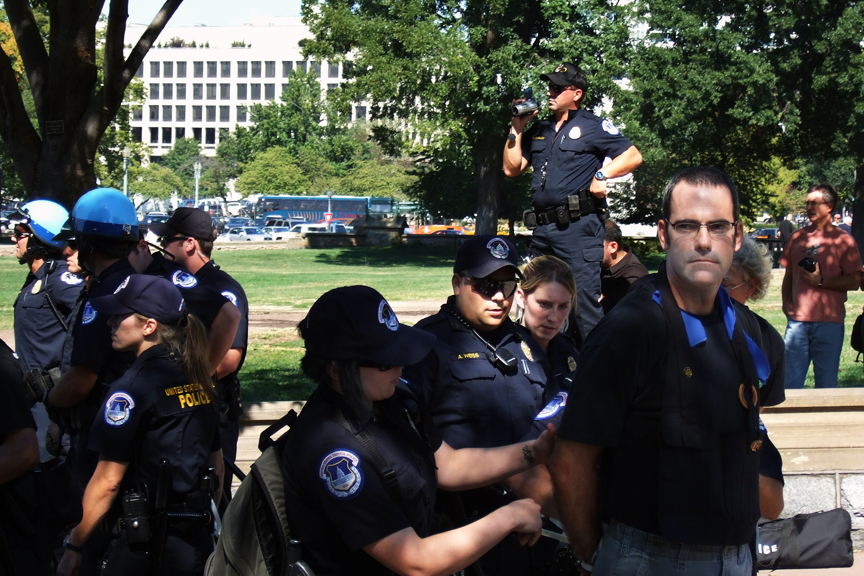
Four members of Witness Against Torture were found guilty in a jury trial at D.C. Superior Court on January 5, 2012. The jury brought back guilty verdicts in the cases of defendants Brian Hynes of the Bronx, NY, Mike Levinson of White Plains, NY, Judith Kelly of Arlington, Virginia, and Carmen Trotta of New York City, NY. Josie Setzler of Fremont, Ohio was acquitted mid-trial after the prosecution’s witnesses failed to identify her.

The demonstrators were charged with one count of disorderly and disruptive conduct on Capitol grounds. The charges stemmed from protests against a Defense Appropriations Bill—a precursor to the recently passed National Defense Authorization Act of 2012 (NDAA)—that took place in the citizen’s gallery at the House of Representatives on June 23, 2011. The protests were in response to provisions in the bill that make it essentially impossible to close the prison in Guantánamo Bay, Cuba and that legalize indefinite detention. 

Prior to the start of the trial, the Prosecutor Brandon Long asked District of Columbia Superior Court Judge Gerald Fisher to disallow any statements regarding Guantánamo into the courtroom fearing that mentioning the detention center and the torture that occurred there “could possibly inflame the jury”. Judge Fisher readily agreed, saying, “Speaking about Guantánamo is inappropriate for the purposes of this trial.” Carmen Trotta responded that it was vital for him to mention Guantánamo Bay because “due process everywhere is being threatened and we have the privilege of due process here, right now.” The judge rejected Trotta’s argument, saying, he “does not want an improper politicization of the defendants’ charge.”

In addition, the judge barred any mention of indefinite detention, torture, President Obama and his policies, including the recently signed NDAA, or the former President Bush and his establishment of Guantánamo, Bagram and various CIA black sites around the world.

Defendants were also unable to appeal to international law as justification for their actions. The Nuremburg principles?  The Universal Declaration of Human Rights? These defenses are not appropriate in DC Superior Court.

The judge even disallowed a reading of the statement the defendants were attempting to deliver to Congress, saying, “The statement made from the gallery is not appropriate for the purposes of this trial.”1

As the trial progressed the prosecutor was intent on focusing on the minutia of the regulation. What is important is a regulation was broken. Decorum was lost! Voices were raised! When the prosecutors claimed that distracting Congress members “causes inefficiencies in the process” I laughed out loud.

The prosecutors relied on the tried and true “time and place” restrictions on free speech, saying the House of Representatives was neither the time nor the place to voice disapproval of Congress, even though they were in fact voting on a bill with provisions to keep Guantánamo open, the very issue the activists went to Congress to discuss.

In closing, Prosecutor Long said, “Rules are rules, the law is the law.” He asked the jury, “Why does it matter? Why should you care that the four defendants stood up and yelled in the House of Representatives?” Answering his own question he said, “It matters because it is the law, the law is important.” Apparently the complete hypocrisy of this statement eluded him. For 10 long years the very government Brandon Long represents have been breaking international and domestic law. There have been no repercussions, no accountability and the current administration continues to act with impunity. After 10 years Guantánamo remains open, 89 men cleared for release remain imprisoned there, many others are imprisoned without due process, and the recently signed National Defense Authorization Act makes their release virtually impossible. Rules are rules, laws are laws!

Bahraini national Jumah al-Dossari was taken into custody by the Pakistani army while trying to leave Afghanistan. According to the testimony he gave Amnesty International, he was imprisoned, robbed, tortured, and then sold to American soldiers searching for potential terrorists. He was detained in Guantánamo for over five years. According to the US military, he attempted suicide at least 12 times during his detention. In a letter written to his lawyer and published in the Los Angeles Times newspaper on 11 January 2007, Jumah al-Dossari wrote, "The purpose of Guantánamo is to destroy people, and I have been destroyed. I am hopeless because our voices are not heard from the depths of the detention centre." He wrote this poem as part of a suicide note sent to his lawyer:

Take my blood.
Take my death shroud and
The remnants of my body.
Take photographs of my corpse at the grave, lonely.
Send them to the world,
To the judges and
To the people of conscience,
Send them to the principled men and the fair-minded.
And let them bear the guilty burden before the world,
Of this innocent soul.
Let them bear the burden before their children and before history,
Of this wasted, sinless soul,
Of this soul which has suffered at the hands of the "protectors of peace."

Indeed. The point of our witness is to enflame passion in the courthouses and the streets! The time and place is here and now, always and everywhere, until Guantanamo is closed and torture is not the law of the land. Join us in our continuing fast and witness and culminating in a mass mobilization in Washington DC Jan 11, 2011. See www.witnesstorture.org for additional information and ways you can support this effort.


1 The statement barred in the House of Representatives and in court as irrelevant read as follows: “Today the House of Representative is in the process of contemplating not the passage of a bill but the commission of a crime. Provisions in the proposed Defense Appropriations Bill grant the United States powers over the lives of detained men fitting of a totalitarian state that uses the law itself as an instrument of tyranny. The law would make the prison at Guantánamo permanent by denying funds for the transfer of men to the United States, even for prosecution in civilian courts.”